




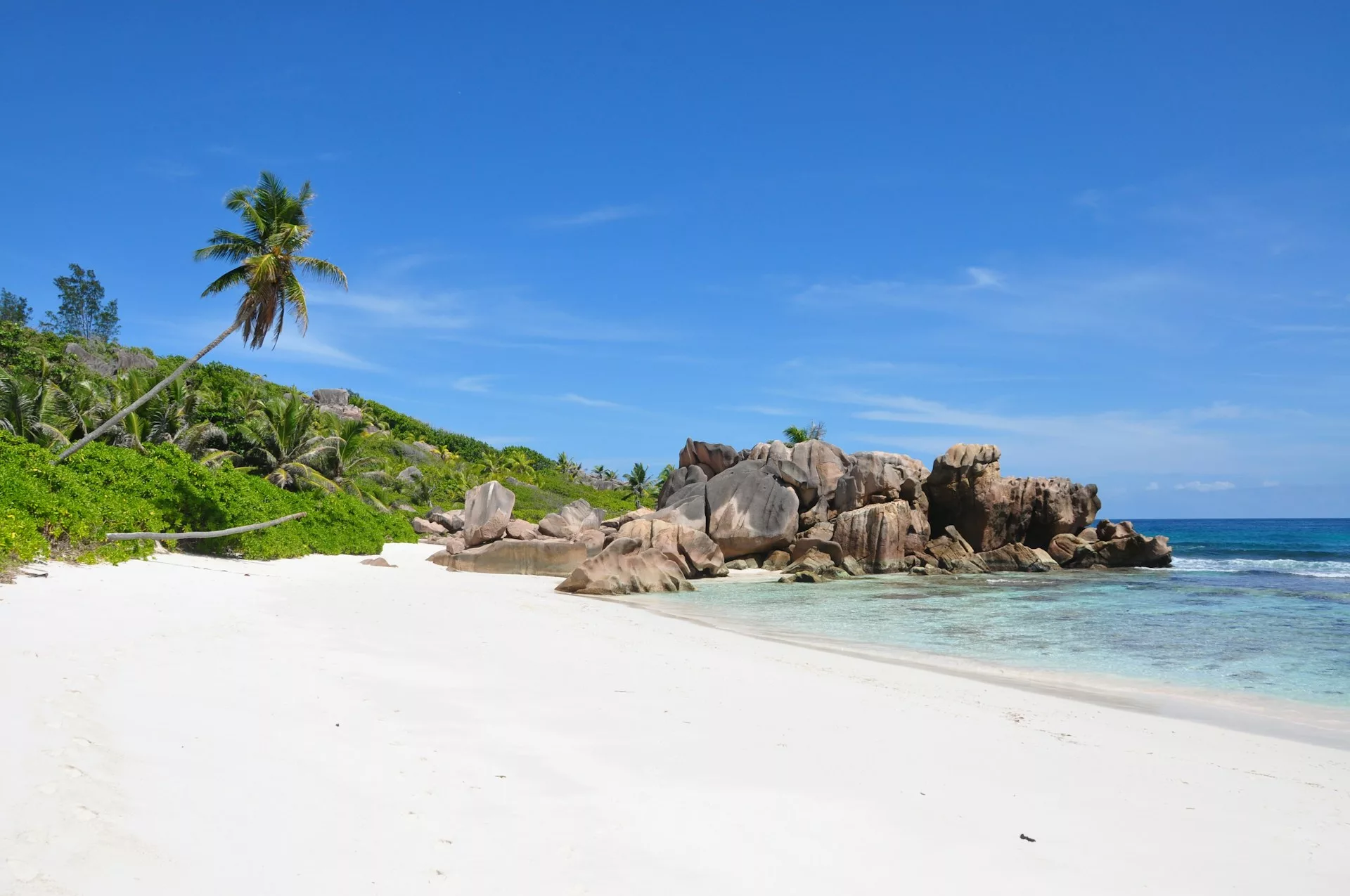

Before you go, it's worth knowing that most of these beaches are straightforward to reach by car, and several are accessible by public bus from Murcia city centre. If you're planning a broader itinerary, the best day trips from Murcia by car includes several coastal options worth combining into a longer coastal loop.
La Manga del Mar Menor: The Strip That Divides Two Seas
La Manga is unlike anywhere else on the Spanish coast. A narrow spit of land — in places no wider than 300 metres — stretches for roughly 22 kilometres, with the calm, warm waters of the Mar Menor on one side and the deeper Mediterranean on the other. You can, quite literally, watch the sun rise over the sea on your left and set into a different sea on your right.
The Mar Menor side is the choice for families. The water rarely exceeds seven metres in depth across the entire lagoon, it warms up earlier in the season (often reaching 28°C by June), and the gentle entry makes it ideal for children and less confident swimmers. The Mediterranean side offers proper beach conditions: longer waves, cooler water, and a more expansive horizon. Both sides have Blue Flag status along significant stretches, and the promenade running through the centre has cafés, ice cream shops, and tapas bars for when the afternoon sun becomes oppressive.
The Murcia Tourism Board lists La Manga as one of its signature coastal destinations, and it's not hard to see why — it's genuinely extraordinary geography made into a very liveable beach resort.
Playa de Los Narejos: The Quiet Mar Menor Alternative
If La Manga feels too developed for your taste, Los Narejos near Los Alcázares offers the same warm lagoon water with considerably fewer sun loungers and considerably more elbow room. This is a long, gently curving beach backed by low dunes and pine trees, popular with Spanish families who have been coming here for generations rather than the international package-holiday crowd.
The shallow gradient makes it exceptional for paddleboarding and kayaking — the Mar Menor's calm surface means even beginners feel confident. Several hire outfits operate along the shore from May through to October. In the early morning, before 9am, the beach is frequently almost empty, and the light across the lagoon at that hour — a flat, pearlescent shimmer — is worth waking up for.
Calblanque: The Unspoilt Coast That Almost Wasn't Saved
Calblanque is, without question, the most spectacular beach zone accessible from Murcia. Protected within a Regional Park, this stretch of coastline escaped the development that consumed most of the Costa Cálida in the 1980s by the narrowest of margins — a planning dispute that locals still talk about with quiet pride. The result is a series of small, largely undeveloped coves with fine golden sand, dunes stabilised by sea grass, and water that shifts from pale turquoise over the sand to deep cobalt further out.
The main beaches — Playa de Calblanque, Playa de las Palmeras, and Playa del Paraíso — are accessible via a short walk from the car parks, which limits the crowd numbers and keeps the environment genuinely pristine. There are no beach bars, no parasol hire, no jet skis. You bring what you need and take it back with you. On a clear day, you can see the outline of the Cabo de Palos lighthouse from the eastern end of the main beach, and the volcanic rock formations framing the western coves glow a deep rust-red in the afternoon light.
Visit the official Calblanque Regional Park page for access information and seasonal restrictions before you go.
Cabo de Palos: Where the Divers Go
The small fishing village of Cabo de Palos sits at the southern tip of the strip separating the Mar Menor from the Mediterranean, marked by a 19th-century lighthouse that has become one of Murcia's most photographed landmarks. The beaches here are less about long sandy stretches and more about rocky coves with exceptional underwater clarity — visibility can reach 20 metres on calm days, which explains why Cabo de Palos is considered one of Spain's premier scuba diving destinations.
The Islas Hormigas Marine Reserve just offshore protects one of the finest reef ecosystems on the Spanish Mediterranean, with grouper, barracuda, and moray eels among the regular sightings. Several PADI-certified dive centres operate out of the village. For non-divers, the village itself is worth the trip for its seafood — the restaurants along the harbour serve caldero, a local rice dish cooked in fish stock that is arguably the signature dish of this entire coastline. If you're building a food itinerary around your coastal trip, the Murcia food guide covers caldero and the broader regional cuisine in considerable depth.
Playa de Bolnuevo: Sand Castles the Landscape Built Itself
Bolnuevo, near Mazarrón, earns its place on this list twice over. First, it's a genuinely lovely beach — wide, sandy, well-organised, with calm water and reliable Blue Flag status. Second, it sits adjacent to one of the most bizarre natural formations on the entire Spanish coast: the Ciudad Encantada de Bolnuevo, a series of sandstone columns and arches sculpted by wind and rain into shapes that do, genuinely, resemble the ruins of a collapsed city. Walking among them in the early morning, when the light hits the pale rock at a low angle, is one of those experiences that stays with you.
The beach itself has proper facilities — showers, lifeguards in season, several beach bars — while the geological formations are free to walk through at any time. Combining both into a half-day trip is easily done.
Playa de la Isla, Mazarrón: Fishing Boats and Family Calm
Puerto de Mazarrón has a working harbour at its heart, and Playa de la Isla curves around one side of it in a wide, sheltered arc. The combination of a proper fishing fleet and a well-maintained family beach gives this place a more authentic character than many of the purely tourist-oriented beaches further up the coast. In the mornings, you can watch the fishing boats returning while the beach is still quiet; by midday, it fills with Spanish families who know exactly what they're doing with a cool box, a windbreak, and six hours of available sunshine.
The water here is calm and clear — the natural curve of the bay provides excellent shelter from the prevailing winds — and the town behind the beach has bakeries, supermarkets, and the kind of no-frills seafood restaurants that charge honest prices because their customers are mostly local.
Playa de Percheles: For Those Who Like the Road Less Travelled
South of Mazarrón, the coastline becomes increasingly dramatic and decreasingly accessible. Percheles is one of a series of small beaches reached via narrow tracks off the main coast road, backed by steep volcanic cliffs and accessible only by those willing to navigate a slightly bumpy descent. The reward is a beach that even in August rarely exceeds a few dozen visitors: dark sand mixed with fine gravel, extraordinary rock formations on both flanks, and water that is spectacularly clear over the rocky seabed.
This is not a beach for facilities — there are none — but for those who find beauty in isolation and don't mind bringing their own supplies, it delivers something the Blue Flag beaches simply cannot.
Playa de las Palmeras, Calblanque: The Dunes Beach
Within the Calblanque park, Las Palmeras deserves its own entry because it offers something slightly different from the main Calblanque beach. Here, a significant dune system backs the sand, stabilised by coastal vegetation but still dynamic enough to feel genuinely wild. The beach is longer and slightly more exposed than its neighbours, which means better conditions for those who enjoy body-boarding or simply prefer a beach with some movement to its water.
The walk in from the car park takes approximately 15 minutes along a well-marked path through scrubland fragrant with wild thyme and rosemary. It's the kind of approach that prepares you for the beach rather than simply depositing you on it.
Santiago de la Ribera: The Mar Menor's Elegant Town Beach
If Bolnuevo is the geological curiosity and Los Narejos is the family hideaway, Santiago de la Ribera is where the Mar Menor gets its most polished expression. The town's beach promenade — the paseo marítimo — is one of the most attractive on the lagoon, lined with palm trees, well-maintained gardens, and a row of excellent restaurants serving fresh fish with views across the perfectly flat water.
The beach itself is wide and sandy, with the characteristic shallow, warm water of the Mar Menor making it popular with older visitors and young children alike. The town is also home to the Murcia Region International Airport — actually located near San Javier, adjacent to Santiago de la Ribera — which makes it a particularly convenient first or last stop for those flying in and out of the region.
Aguilas: Three Beaches and a Castillo
The town of Águilas, at the southern extreme of Murcia's coast, sits between a Moorish castle on a headland and a cluster of beaches that between them cover almost every preference. Playa de las Delicias is the main town beach — Blue Flag, well-serviced, lively in summer. Playa Poniente is the longer alternative, backed by low dunes and less crowded. And the area around Cabo Cope, a short drive north, offers some of the most dramatic coastal scenery in the region: towering headlands, isolated coves, and near-total absence of development.
Águilas is also famous for its carnival — one of the biggest in Spain — and for its exceptional seafood. The combination of a proper working town with genuinely outstanding beaches gives it a depth that purely resort-based destinations lack. The Águilas Tourism website has detailed maps of all the coves and beaches accessible around the cape.
Playa de Bahía, Cartagena Coast: History Meets Coast
The coastline immediately east of Cartagena — the ancient city that rivals Murcia for historical significance in the region — includes several beaches that make perfect sense as part of a combined cultural and coastal day. Playa de Bahía near La Azohía is a particular highlight: a curved, pebbly cove with exceptionally clear water sheltered by the Cabo Tiñoso headland, backed by pine-covered hills, and overlooked at a distance by a clifftop military watchtower of considerable age.
The combination of history, landscape, and swimming makes this stretch ideal for those who find a day spent purely on a beach slightly underambitious. Cartagena's Roman theatre, Punic walls, and excellent Museo del Teatro Romano are less than 30 minutes away and can easily absorb a morning before an afternoon at the beach.
Playa Honda: The Wind Sport Capital of the Mar Menor
Playa Honda, on the western shore of the Mar Menor near San Javier, is included here for a specific reason: consistent wind. While most beaches on the lagoon attract visitors seeking flat calm, Playa Honda catches enough of the prevailing levante wind to make it one of the best locations on the entire Spanish coast for windsurfing and kitesurfing. Several schools operate here year-round, and the conditions — strong enough for sport, with the shallow, warm water providing a forgiving environment for learners — have built a dedicated community of enthusiasts who return season after season.
For non-participants, watching a skilled kitesurfer work the wind above the flat blue lagoon is entertainment enough. And the beach itself, away from the equipment zones, is perfectly pleasant for straightforward swimming and sunbathing.
Getting There and Planning Your Visit
Most of these beaches are between 45 minutes and 90 minutes from Murcia city by car. The Mar Menor beaches are well-served by LatBus regional services running from the city, making car-free access realistic for La Manga, Santiago de la Ribera, and Los Narejos. For Calblanque, Bolnuevo, Águilas, and the more remote coves, a hire car is essentially necessary — the final stretches involve roads that public transport doesn't serve.
Peak season runs from late June through to early September, when temperatures regularly exceed 35°C inland and the beaches fill rapidly by late morning. The optimal visiting windows are late May to mid-June, and September, when the sea is warm from the summer's heating but the crowds have thinned significantly. October remains pleasant for beach walks and coastal exploration even if swimming feels ambitious to northern European sensibilities.
If you're building a full itinerary around Murcia, the coastal day trips slot naturally alongside the city's considerable cultural offering. The 25 things to do in Murcia guide covers the urban highlights — the cathedral, the tapas bars, the Salzillo Museum — that make the city worth a day or two before or after your coastal explorations.
The real secret of Murcia Spain beaches is their variety. Within a 90-minute radius of a single city, you have Europe's largest saltwater lagoon, protected natural parks with genuinely undeveloped coastline, volcanic rock formations, world-class diving, and elegant promenade towns with serious seafood credentials. Most visitors focus on one area and miss the rest entirely. The smarter approach is to base yourself in Murcia city — where the food, the architecture, and the evening culture are legitimately excellent — and use the coast as it deserves to be used: with intention, variety, and the understanding that each of these beaches rewards a slightly different version of a perfect day.

Standard Minivan
 5
5
from just €7.65 per person
Group travel? Perfect option is our minivan, 5 passengers and 4 medium suitcases

Standard Saloon
3
from just €10.20 per person
Travel in comfort in these late model saloons, takes 3 passengers and 2 medium suitcases

Large Standard Minivan
8
from just €11.05 per person
Group travel? Perfect option is our large minivan, 8 passengers and 6 medium suitcases

Executive Saloon
3
from just €17.00 per person
Travel in style in these late model saloons, takes 3 passengers and 2 medium suitcases

Standard Minibus
9
from just €18.70 per person
Group travel? Perfect option is our minibus with upwards of 9 passengers and 9 medium suitcases

Luxury Saloon
3
from just €22.95 per person
Travel in luxury in these late model saloons, takes 3 passengers and 2 medium suitcases
Door to door private airport transfers to your destination, anywhere!
Ride Transfer Direct is a company dedicated to quality airport transfers globally. Our team have over 60 years of experience delivering services in the most popular destinations around the world